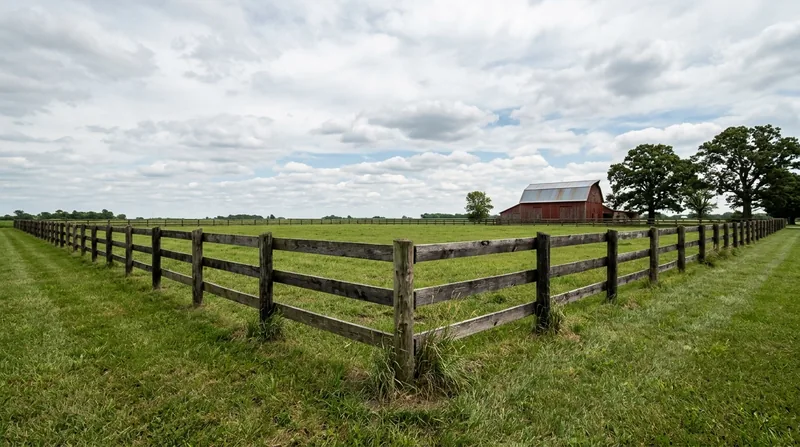




Des Moines sits where the Des Moines and Raccoon Rivers meet, and just outside the city limits the terrain opens into flat to gently rolling acreage on dense glacial till clay and black prairie loam. That ground is hard on fence posts. It heaves them with every freeze-thaw cycle in February and softens them at the ground line through wet Iowa springs. If you are looking for farm fence installation in Des Moines, the job is less about pretty panels and more about braced corners, deep-set posts and long straight runs that stay tight after ten winters of prairie wind. We build ranch rail, no-climb horse fence, field wire and pipe fencing for homesteads and working acreage around Polk City, Madrid and Carlisle, and we size every gate for the trailer or tractor that actually has to pass through it. The same crews who set your corner posts are the ones who come back when a brace works loose.
Why Acreage Fencing Fails Differently Around Des Moines
City lots and acreage do not share the same failure modes. On a half-acre in Beaverdale, a leaning privacy fence is usually a rotted post at the ground line. On forty acres outside Norwalk, the problem is scale: long runs of field wire stretch and sag, corners pull under livestock pressure, and a single unbraced corner can drag a hundred feet of line out of plumb. The clay and loam here hold water in spring and then shrink hard in a dry August, so a post tamped shallow will walk. The prairie wind and derecho-strength gusts that flatten subdivision panels do the same to a poorly braced ranch fence, only over a longer span.
- Freeze-thaw cycles heave shallow posts and open gaps under gates that were hung tight in July.
- Wet spring ground rots wood posts at the ground line, which is where every post eventually fails.
- Long runs without intermediate bracing sag under their own weight and under livestock pressure.
- Corners set without a proper brace assembly pull out first when a horse leans on the line.
- Gates sized for a riding mower do not pass a stock trailer, and widening one later costs more than sizing it right.
Most of these are fixable with better bracing and deeper posts, which is cheaper than replacing a fence line that was set too light to begin with.
Key info: On the low river-bottom ground along the Des Moines and Raccoon Rivers, posts sit in soil that stays wet far longer than the upland clay. We set those corners deeper and brace them heavier, because a corner that holds on a Madrid ridge will not necessarily hold down in the bottoms.
Fence height, setback and corner-visibility rules are set by the city or county and vary across Greater Des Moines, so check with the local building department before you stake a line. For projects at or above $40,000, Iowa law requires a licensed general contractor. You can review Iowa contractor and project requirements through the Iowa Division of Labor.
How We Build a Farm Fence Line That Stays Tight
We start by walking the fence line with you and marking it, working from your existing survey and installing on the line you identify. Iowa 811 utility locates are required by law before any post hole is dug, so we call and wait. From there the work is straightforward and repetitive, which is exactly what a good fence line should be. Straight runs, consistent post spacing, braced corners and gates hung to swing clear.
- We walk the line and confirm the route, gate locations and what the fence has to hold.
- We call 811 for utility locates and wait for the marks before digging.
- We set corner and end posts deep and brace them, because every long run depends on those anchors.
- We run the line posts at consistent spacing and keep the top line straight over rolling ground.
- We hang gates sized for your trailer, tractor or equipment and set them to swing clear of the ground.
- We tension wire and mesh properly and walk the finished line with you before we leave.
If a section of existing fence only needs new posts and re-tensioning, we will tell you that instead of quoting a full replacement.
Key info: A recent job near Polk City ran a quarter mile of no-climb horse fence along a property line with a 12-foot equipment gate at the drive. The ground rolled about six feet over the run, so we stepped the fence rather than racking it, which keeps the mesh tight and the top line clean from the road.
If your acreage also needs a driveway gate with an operator, that work pairs naturally with the fence line and is handled on our automatic and driveway gates page.
Farm Fence Options We Install Across Central Iowa
The right fence depends on what you are keeping in and what has to get through. Horses need something they can see and will not catch a hoof in. Cattle and field boundaries are a different calculation. The table below lays out the main approaches and where each one earns its keep on central Iowa ground.
| Approach | Description | Best for |
|---|---|---|
| Split rail | Wood rails on set posts, two or three rail, stepped on rolling ground. | Ranch boundaries, driveways and decorative acreage lines. |
| No-climb horse fence | Woven wire mesh with a small opening, tensioned between braced posts. | Horse pastures and turnout where safety matters most. |
| Pipe fence | Welded steel pipe in a rail or continuous configuration. | Working pens, heavy-use areas and high-traffic corrals. |
| Barbed wire | Tensioned wire strands on braced wood or steel posts. | Cattle and field boundaries over long rural runs. |
| Field wire | Woven or welded wire mesh for containment and boundary lines. | General acreage boundary and livestock containment. |
We will tell you plainly when a cheaper configuration will hold and when it will not, because a fence that fails in year three costs more than the one built right the first time.
Farm & Ranch Fencing Cost in Des Moines: What to Expect
Farm fencing is priced by the linear foot, and the honest starting point for most ranch rail and wire work is from $12/ft. That figure covers the basic materials and labor for a straightforward line on open ground. What moves it up is almost always the ground and the access, not the fence itself.
- Run length matters: a quarter mile is priced better per foot than two hundred feet because setup is spread over more line.
- Corner and gate count drive labor, since every corner needs a braced post assembly set deep.
- Terrain adds cost: rolling ground needs stepped installation and more careful post setting than flat pasture.
- Access limits equipment, and a line you cannot reach with a truck or auger costs more to build.
- Material choice moves the number most, with pipe and heavy no-climb mesh at the top and field wire at the bottom.
- Clearing brush or old fence out of the way is real labor and gets quoted as such.
Get two or three estimates on the same marked line, and make sure each one is quoting the same post spacing and bracing, because that is where cheap quotes hide. Our full pricing overview breaks down the detail behind these numbers.
Choosing a Fence Contractor Near Des Moines
Anyone with a post driver can sell you a fence line. The difference shows up in year five, when the corners are still plumb and the gates still swing. Ask direct questions before you sign anything, and expect direct answers.
- Ask for a certificate of insurance showing general liability and workers' compensation cover before work starts.
- Fence licensing here is set by the state and county, so confirm what your jurisdiction requires and ask for proof of whatever applies.
- Get multiple estimates on the same marked line and compare bracing and post spacing, not just the total.
- Ask for references on acreage work, not just subdivision privacy fences.
- Confirm who pulls any required permit and who calls 811 for utility locates.
- Check HOA and deed restrictions if your acreage sits inside a master-planned community.
We are fully insured and can provide a certificate of insurance on request, and we work from your existing survey on the line you identify. Reach out through our contact page to set up a walk of the line.
Farm & Ranch Fencing Near Me: Getting the Line Right the First Time
When people search for farm and ranch fencing near me, what they usually need is a crew that will show up, walk the ground and give a straight answer about what will hold. Central Iowa ground is unforgiving to shortcuts. Posts set shallow heave, corners braced light pull, and gates hung without room for frost movement bind every February. We build for that from the first post, and we repair before we recommend replacement whenever the existing fence justifies it.
Whether you are fencing ten acres near Indianola or tightening up a horse pasture outside Grimes, the conversation starts the same way. Call (515) 528-3444 and we will walk the line with you.
Farm & Ranch Fencing in Des Moines: Pricing Guide
| Service | Price | Details |
|---|---|---|
| Split rail fence installation | Starting at $12/ft | Two or three rail wood line on set posts, stepped over rolling ground, priced per linear foot. |
| No-climb horse fence installation | Starting at $16/ft | Woven mesh tensioned between braced posts, sized for horse safety and pasture turnout. |
| Pipe fence installation | On estimate | Welded steel pipe for pens and heavy-use areas, quoted after an on-site look at layout. |
| Barbed wire or field wire | Starting at $9/ft | Tensioned wire on braced wood or steel posts for cattle and long field boundaries. |
| Travel | Included | In Des Moines and surrounding counties, with no separate call-out or mileage fee added. |
| Estimate | Free | Response within 24 hours at (515) 528-3444, with no obligation to book the work. |
Indicative pricing, the exact cost depends on square footage, finish, and site access. Free personalized estimate within 24h at (515) 528-3444.


