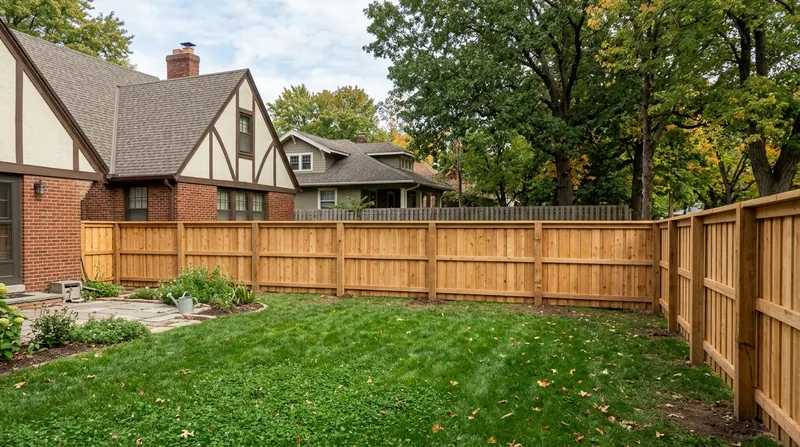




Privacy Fence Installation in Des Moines: Built for Iowa Clay and Hard Winters
When you need privacy fence installation in Des Moines, the ground under your yard matters as much as the lumber above it. Most lots here sit on dense glacial till clay and black prairie loam over full basements, and the freeze-thaw cycles that roll through Sherman Hill, Beaverdale and the East Village heave a shallow post out of plumb in a single winter. We build the classic 6-ft cedar privacy fence this city grew up with, setting pressure-treated posts deep in concrete and hanging cedar or treated-pine pickets board-on-board or side-by-side. The same crews who dig the holes set the rails and hang the gates, so nothing gets lost between the sales call and the install. We tell you straight when cedar earns its price and when treated pine is the smarter budget call. If you are comparing materials before you commit, start with our vinyl and PVC fence options to see how the two hold up against an Iowa spring.
Why a Wood Privacy Fence Matters on a Des Moines Lot
Des Moines is a capital city at the meeting of the Des Moines and Raccoon Rivers, and its neighborhoods were platted tight. Victorian and Queen Anne homes on narrow Sherman Hill lots, Craftsman bungalows in Beaverdale and brick ranches in Merle Hay all share one thing: side yards measured in feet, not acres. A 6-foot privacy fence is often the only way to get a usable back yard out of a 50-foot lot. The prairie wind and derecho-strength gusts that cross Polk County also flatten cheap panels, so post spacing and concrete matter more here than in a sheltered suburb.
- Narrow side yards in the East Village and Highland Park leave little room for error on the fence line.
- Wet springs rot posts at the ground line, which is the failure we repair most often in older neighborhoods.
- Heavy snow banks lean on fence lines through February and stress rails that were set too light.
- Newer vinyl-sided subdivisions in Waukee and Grimes often carry HOA standards that govern height, material and color.
Build for those four pressures and a wood fence here will outlast the mortgage that paid for it.
Key info: In Beaverdale and Waterbury, we routinely find original posts set only 18 to 24 inches deep in clay. Modern practice sets them 30 to 36 inches with a concrete collar, which is what stops the heave that racks a gate out of square by March.
For the official rules on fence height, setbacks and permits, check the city's own pages before you buy materials: City of Des Moines.
How We Build a Wood Fence in Des Moines, Step by Step
Every job starts with an 811 utility locate, which Iowa law requires before anyone turns a shovel. From there we walk the line with you, mark the corners, and confirm the layout against your existing survey. You identify the property line; we install on it. We do not survey, and we will not guess where a boundary sits. Once the line is agreed, the sequence is the same on a bungalow lot in Drake as on an acreage outside Polk City.
- We call 811 and wait for the utility locates to clear before digging.
- We set pressure-treated posts in concrete at 6- to 8-foot spacing, deeper on the river-bottom ground along the Raccoon.
- We hang top and bottom rails, then pickets board-on-board or side-by-side to match the look you want.
- We rack or step the panels to follow grade instead of forcing a level line over a slope.
- We hang gates with anti-sag bracing and self-closing, self-latching hardware where code calls for it.
- We cap and trim the run, clean the site, and walk the finished fence with you.
That sequence is why a fence built here in October is still hanging square after the February thaw.
Key info: On a sloped yard in Windsor Heights, we stepped the panels rather than racking them, because the grade dropped 20 inches across the run. Stepping keeps the pickets vertical and the bottom rail off the dirt, which is where rot starts.
If your existing line is failing post by post rather than all at once, our fence post repair and replacement service often saves the pickets and rails you already paid for.
Wood Privacy Fence Styles We Install Around Des Moines
The style you pick drives both the look and the price. A board-on-board run gives full coverage with no see-through gaps, while a side-by-side run uses fewer pickets and costs less per linear foot. Cedar resists rot and holds stain well; pressure-treated pine costs less up front and takes stain reliably when it is dry. We build all four of the common approaches and tell you which one fits your lot, your budget and your HOA.
| Approach | Description | Best for |
|---|---|---|
| Board-on-board cedar | Overlapping pickets on both sides of the rails for full privacy and a finished look. | Narrow side yards in Beaverdale and the East Village. |
| Side-by-side cedar | Pickets butted edge to edge on one side of the rails, lighter on material. | Back-yard runs where budget matters more than a two-sided finish. |
| Treated-pine privacy | Pressure-treated pickets and rails, stained after the wood dries. | Rental properties and long runs on a tighter budget. |
| 6-foot privacy with cap and trim | Cedar pickets finished with a cap rail and trim for a crisper line. | Front-facing runs in Waterbury and newer Ankeny subdivisions. |
Wood & Privacy Fence Installation Cost in Des Moines: What to Expect
Most wood privacy fence work here starts at $27 per linear foot, and that figure buys a standard 6-foot run with pressure-treated posts set in concrete and cedar or treated-pine pickets. The number moves with the variables below, and it moves fast on a tight urban lot. Two or three estimates on the same layout is the only way to know you are comparing apples to apples, because one bid may exclude removal, staining or the gate hardware another includes.
- Total linear feet drives the base number more than any other single factor.
- Access matters: a fence line you can only reach through a basement window costs more than one a truck can back up to.
- Cedar costs more than treated pine up front and less over time in stain and replacement.
- Proximity to structures, mature oaks and buried utilities slows the dig and adds labor.
- Removal of an old fence and hauling are quoted separately from the new install.
Our full pricing overview breaks down the add-ons so you can budget before the estimator arrives.
Hiring a Fence Contractor Near Me in Des Moines: What to Check
Anyone with a truck can quote a fence. The questions that separate a real fence contractor from a storm chaser are boring, and they are the ones that save you a season of grief. Fence licensing in Iowa is set jurisdiction by jurisdiction, so ask the company how the rules apply where you live and confirm the answer with the city or county building department. Ask for a certificate of insurance showing general liability and workers' compensation cover, and ask for two or three local references you can actually call.
- Confirm the company carries general liability and workers' compensation cover, and get the certificate before work starts.
- Ask who pulls the permit where one is required, and who is responsible if the inspection fails.
- Check references from jobs in your own neighborhood, not just anywhere in the metro.
- Ask how the crew handles HOA architectural standards in master-planned communities around Ankeny and Waukee.
- Confirm the crew calls 811 before digging, every time, no exceptions.
We are fully insured and can provide a certificate of insurance on request, and we work from your existing survey on the line you identify. When you are ready to talk layout, reach us through the contact and free estimate page.
Wood & Privacy Fence Installation Near Me: What Des Moines Homeowners Should Know
The biggest surprise for a first-time fence buyer in Des Moines is how much the weather sets the schedule. Ground here freezes hard, and a post hole dug in frozen clay is a fight nobody wins. We book wood fence installs from spring through late fall, with the busiest stretch running from April through June, when homeowners walk out after the thaw and find last winter's heave. Late summer and early fall are the sweet spot for staining, because the wood has dried and the humidity has dropped.
The failure mode that dominates this city is post rot at the ground line after a wet spring, not wind. A post set in concrete with no drainage collar will wick moisture and fail at the soil line in eight to twelve years. When we see that, we propose replacing the posts and saving the pickets and rails rather than tearing out a fence that still has a decade of life in it.
If you are weighing materials for a new run, our guide to fence installation in West Des Moines covers how the newer subdivision lots differ from the older city grid. Call (515) 528-3444 and we will walk your line with you.
Wood & Privacy Fence Installation in Des Moines: Pricing Guide
| Service | Price | Details |
|---|---|---|
| Standard 6-foot cedar privacy fence | Starting at $27/ft | Pressure-treated posts set in concrete, cedar pickets, top and bottom rails, includes basic gate. |
| Board-on-board cedar privacy fence | Starting at $34/ft | Overlapping pickets on both sides of the rails for full coverage; material volume drives the higher rate. |
| Treated-pine privacy fence | Starting at $23/ft | Pressure-treated pickets and rails, budget-friendly option; staining quoted separately after wood dries. |
| Removal of existing fence | Starting at $6/ft | Tear-out, haul-away and disposal of old panels and posts; concrete footings add labor. |
| Complex or large-scale job | On estimate | Sloped lots, tight access, utility conflicts or runs over 200 feet need an on-site look before pricing. |
| Travel | Included | in Des Moines and surrounding areas, no separate call-out or mileage fee |
Indicative pricing, the exact cost depends on square footage, finish, and site access. Free personalized estimate within 24h at (515) 528-3444.


